How to make your presentation or speech fit a time limit (and not run over)
Published October 24, 2026 · 6 min read
To make a talk fit a time limit, turn the slot into a word budget (minutes times your speaking pace), write or trim to about 10 percent under it, time yourself reading it out loud, and mark one section you can drop if you are running late. Never fix a long script by talking faster.
This works for a conference slot, a class presentation, a pitch or a video with a strict length, and it needs nothing more than a timer and a word counter.
Step 1: turn the time slot into a word budget
Most people speak at roughly 130 to 160 words a minute in a relaxed talk. Multiply your minutes by your own pace to get a budget. At 140 words a minute, 5 minutes is about 700 words and 10 minutes is about 1,400.
Measure your own pace once: read a paragraph aloud for exactly one minute and count the words. Our guide on words per minute shows how.
If you use slides, count the pauses too. A slide change, a demo or a question takes time that words do not.
Step 2: aim for about 10 percent under the limit
Talks almost always run long: live you add asides, pause for reactions and stumble. Plan for a little less than the slot, so the real thing lands on time instead of over it.
- For a 10-minute slot, prepare about 9 minutes of material.
- Cut whole points before you cut words from every point.
- Keep the opening and the closing exact; shorten the middle.
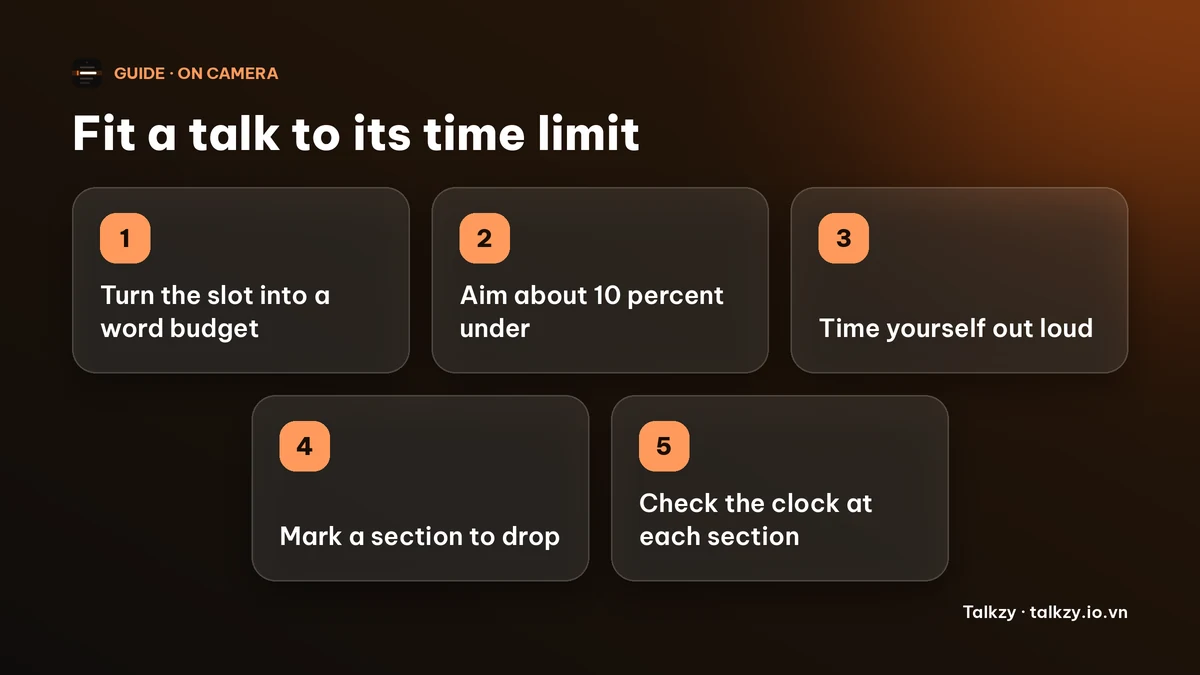
Step 3: time yourself out loud, standing up
Silent reading is much faster than speaking, so a run-through in your head always comes out too short. Say the talk out loud at the pace you will really use, with your slides, and time it.
- 1Run it once start to finish without stopping, and note the time.
- 2If it is over, cut a point. Do not speed up.
- 3Run it again. Two or three timed runs are usually enough.
Step 4: write down a time for each section
Split the talk into sections and write the time you should reach at the end of each: for a 10-minute talk, for example, the intro by 1:00, point one by 4:00, point two by 7:00, the close by 9:30. A glance at the clock then tells you whether to trim, not just that you are late.
Mark one section you can skip or shorten if you are behind. Dropping a prepared point calmly sounds better than racing through all of them.
Step 5: check the clock, not your nerves
Adrenaline makes people talk faster, so a talk that was on time at home can finish early, and one with many asides can run over. Put a clock or timer where you can see it, and compare it with your section times. If you are behind, drop the marked section; if you are ahead, slow down and pause rather than adding new content.
Where Talkzy helps
Talkzy for Mac is a script bar that hangs from the MacBook’s notch. It is on the Mac App Store for macOS 14 or later.
- The editor shows your word count and the read time at your chosen pace, for example “words · 5:00 at 140 WPM”, so you can trim until it fits.
- You can set a fixed speed from 60 to 260 words per minute, in steps of 5, or let it follow your voice. Speech recognition runs on the device.
- While the script runs, the bar shows the time left.
That is an estimate from word count and pace, not a recording of your real talk, so still time at least one run out loud. The iPhone and iPad app is coming soon to the App Store.
Frequently asked questions
- How many words is a 10-minute speech?
- About 1,300 to 1,600 words at a relaxed pace of 130 to 160 words per minute. Measure your own pace by reading a paragraph aloud for one minute, then multiply by the minutes you have.
- How do I know if my presentation is too long?
- Say it out loud with your slides and time it. Silent reading is faster than speaking, so only a spoken run-through is reliable. If it is over, cut points rather than speeding up.
- What should I do if I am running out of time during a talk?
- Skip the section you marked as optional and go straight to your closing. Do not talk faster to fit everything in.
- Should I prepare less than the full time?
- Yes, usually about 10 percent less. Pauses, reactions and asides take time, so a slightly shorter plan lands on time.