How to read a eulogy without breaking down (and what to do if you do)
Published November 12, 2026 · 5 min read
You probably cannot promise yourself that you will not cry while reading a eulogy, and you do not need to. What you can do is make the reading survivable: put the words in large type you can read through tears, rehearse until they hit less hard, write the pauses in, and decide in advance what you will do if your voice goes. A pause to breathe is something people in the room expect and forgive.
This guide covers the text, the rehearsal and the moment itself. It works with printed paper or any notes app. The last section says where a teleprompter app can help and where it cannot.
Is it normal to cry while giving a eulogy?
Yes. A room at a funeral or memorial is on your side. Guests do not judge a shaky voice or a stop to breathe; they usually feel closer to you for it. Planning to get through it perfectly adds pressure, so plan instead to get through it at your own speed.
How should I prepare the text so I can read it through tears?
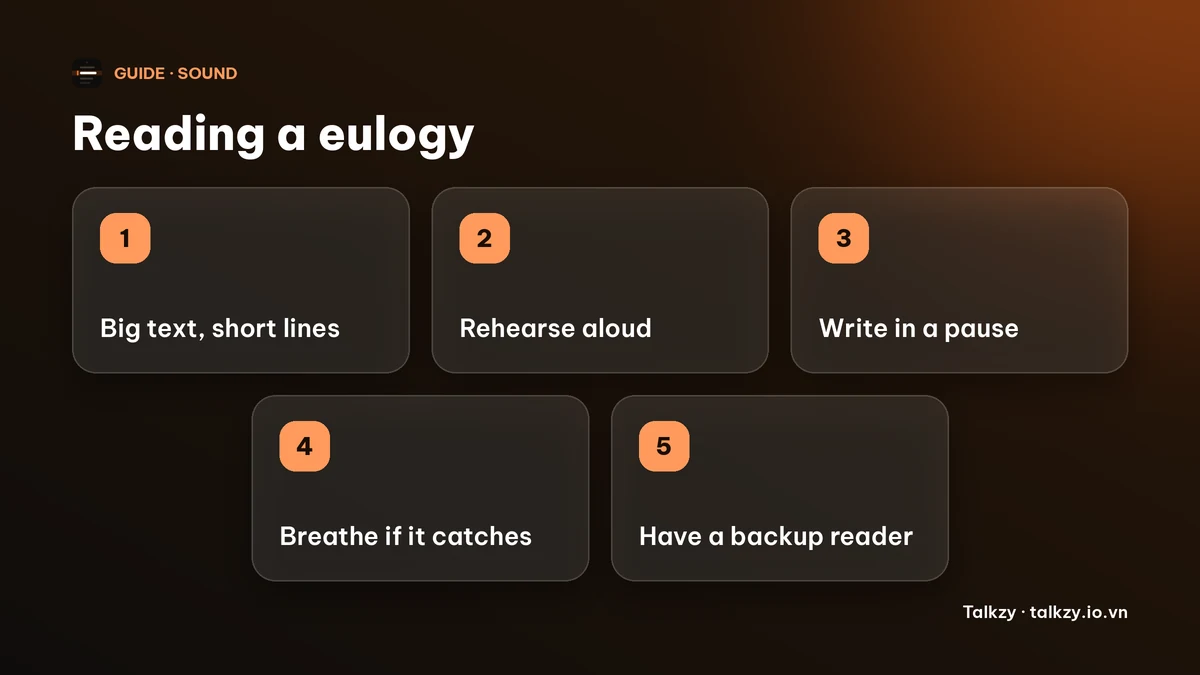
- Use large type, larger than looks sensible. If your eyes blur, big letters are still readable. Many people print in a 14 to 16 point font or bigger, double-spaced.
- One idea per line, with a blank line between paragraphs, so you can find your place again after a pause.
- Write the way you talk, in short sentences. Long sentences make you run out of breath exactly when your voice is least steady.
- Put the hardest lines in the middle of the speech rather than as the very last words, if you can. Ending on a warmer memory gives you something steadier to finish on.
- Write a pause marker, such as a slash or “(breathe)”, after the lines that are hardest to say.
- Keep it to the time you were given. A short eulogy that you finish is better than a long one that you cannot.
How do I rehearse so it is less overwhelming on the day?
Reading the words out loud again and again does not make them mean less, but for many people it makes them less of a shock. The first read-through is often the hardest. By the fifth you know where your voice will catch and you can plan for it.
- 1Read it aloud, standing, at least three times over several days, not all at once.
- 2Mark every place where you tear up, and decide: keep a pause there, shorten the line, or move it.
- 3Rehearse the pause itself: stop, look at the page, breathe in slowly, breathe out, and read the next line. Do it until it feels ordinary.
- 4Read it once to a friend or family member, so the first time anyone hears it is not at the service.
- 5Do a last run the day before, then stop. You do not need to rehearse right up to the minute.
What can I do in the moment if my voice goes?
Stop talking, look down at the page, and take a slow breath in through your nose and out through your mouth. Sipping water helps, so keep a glass nearby. Count to three, then read the next line at a slower pace than before. Silence of a few seconds feels very long to you and much shorter to the room.
It also helps to look at the line, not the people, while you steady yourself. Look up again when you reach a line you know well.
If you cannot continue, a backup plan removes the fear. Before the service, ask a friend or relative to stand near you, give them a copy of the text and agree that they will take over from where you stop. Most people never need it, but knowing it exists is what lets you relax.
Which is better: paper or my phone?
Either is fine; choose the one you can read most easily when you are upset. Paper cannot lock, show a notification or run out of battery, and you can see the whole page, so it is a good default. A phone lets you use very large type and keeps the text in your hand without a rustling sheet.
If you use a phone, turn on Do Not Disturb and set the screen to stay on, and bring a printed copy in your pocket as a backup. Hold the phone at chest height and do not scroll with a shaky finger at the key lines. The guide on reading a toast from your phone covers the hold and the format in more detail.
Where can a teleprompter app help?
Talkzy’s iPhone and iPad app has a prompter-only mode, which shows your script as large text with no camera. It is free. You can set the text size from 24 to 120 pt and choose manual scrolling, so the text moves only when you move it, or timed scrolling at 60 to 260 words per minute. The screen stays awake while the prompter is open. Talkzy for iPhone and iPad is on the App Store.
For a eulogy, manual scrolling is usually the better choice, since the text never moves while you are stopped to breathe. Talkzy cannot write the eulogy for you and it does not make it easier to say; rehearsal does. A printed page or any notes app in big type does the same job.
Frequently asked questions
- How do I read a eulogy without crying?
- You may not be able to avoid it, and that is fine. Rehearse aloud several times so the words lose some of their shock, use large type, write pauses into the text and plan to stop and breathe if your voice goes.
- What if I cannot finish the eulogy?
- Ask a friend or relative to stand near you with a copy and agree that they will take over where you stop. Many people never need to, but knowing it is possible makes it easier.
- Should I read a eulogy from paper or from my phone?
- Whichever you can read most easily when you are upset. Paper is the safest default; a phone is fine with large text, Do Not Disturb on and a printed copy in your pocket.
- How long should a eulogy be?
- Follow the time the family or officiant gives you. Short eulogies are common, and one you can finish is better than a long one you cannot.
- Can Talkzy help me read a eulogy?
- Its free prompter-only mode shows your text large on an iPhone or iPad with manual scrolling and the screen kept awake. It does not write the eulogy.