How to stop running out of breath when you read a script aloud
Published November 7, 2026 · 5 min read
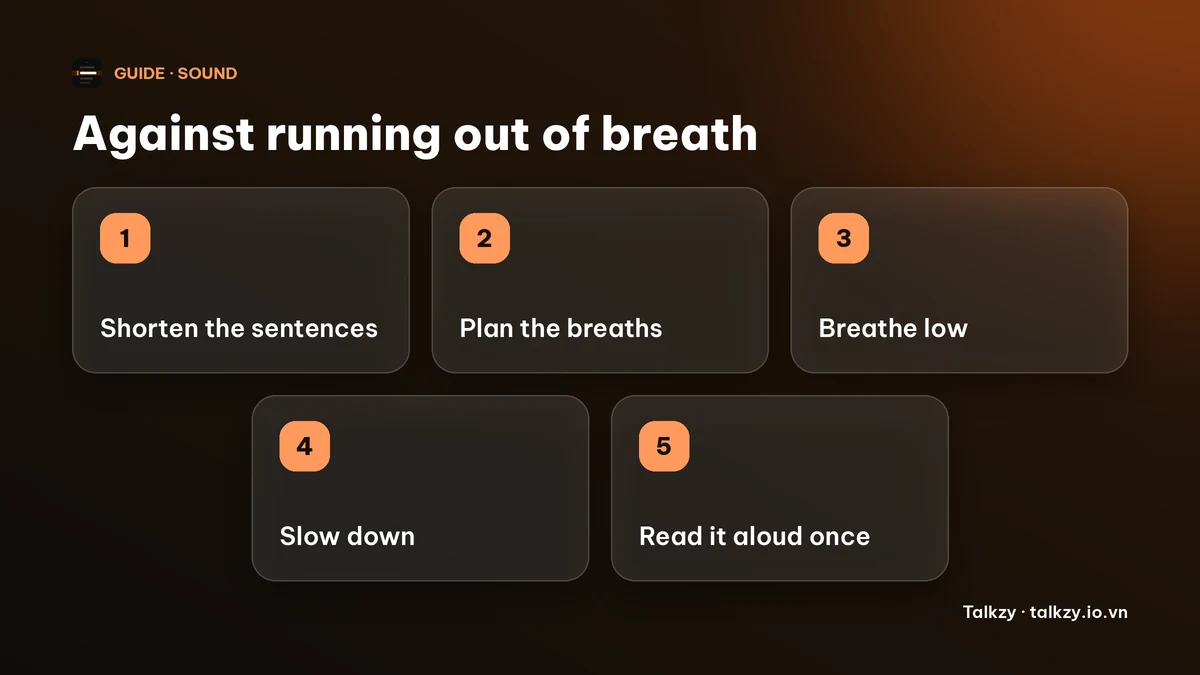
To stop running out of breath when you read a script aloud, shorten any sentence you cannot say in one breath, plan a breath at every full stop and before long phrases, breathe low into your belly instead of lifting your shoulders, and read slower than feels natural. Most breathlessness is a script written for the eye, plus nerves that speed you up.
This guide explains why it happens, how to find the problem lines, how to practise breathing while you speak, and how a script on screen can give you room to breathe. It is general speaking advice, not medical advice: if you get short of breath doing ordinary things, or it comes with pain or dizziness, see a doctor.
Why do I run out of breath when I read aloud?
Three causes are common. Written sentences are longer than spoken ones, so a line that looks fine on a page needs more air than you have. Nerves make you breathe high and shallow, so you start each sentence with less air. And reading makes you hurry: when your eyes are busy finding the next word, you push on without the pauses you would take in conversation.
The result is the familiar pattern: a strong start, a thin voice at the end of the sentence, a gasp, and a rush into the next one. Listeners hear the gasp, and a microphone close to your mouth makes it louder.
How do I find the lines that run me out of air?
- 1Read the script aloud once at the pace you plan to use, with a pencil or your cursor in hand.
- 2Mark every place where your voice faded, you gasped or you sped up to finish.
- 3Count the words in those sentences. Spoken sentences that feel comfortable are often in the range of 10 to 20 words, though it depends on you and on your pace.
- 4Those are the lines to split, not the lines to power through.
How do I rewrite a script so it fits a breath?
- Split long sentences at “and”, “but”, “which” and “because”. Two short sentences are easier to say than one long one.
- Put one idea on each line. A new line is a built-in cue to breathe, and it helps you find your place.
- Cut lists of three or four things down to what the viewer needs.
- Use contractions (“it’s”, “you’ll”) the way you would speak.
The pause-marking guide shows how to add slashes for breaths and a longer beat.
| Before | After |
|---|---|
| When you are setting up your camera, which should be at eye level, make sure that the light is in front of you and not behind you because otherwise your face will be dark. | Set your camera at eye level. / Put the light in front of you, not behind. / Otherwise your face goes dark. |
How should I breathe while I speak?
- Breathe low. Let your belly move out a little as you breathe in, and keep your shoulders still. A high chest breath gives you less air.
- Breathe in at the pauses you planned: the end of a sentence, or a comma where the sentence is long. A quick breath through the mouth is fine and quiet if you do it at the pause.
- Do not wait until you are empty. Top up before you need to.
- Let the last words of a sentence fall off at their natural pace instead of squeezing out a final word on fumes.
- Sit or stand tall with your chin level, so your throat is open. Slumping over a laptop squeezes your lungs.
A one-minute warm-up of slow breaths in and long, even breaths out, before you start, helps your first sentences. The voice warm-up guide has a full routine.
What if I lose my breath in the middle of a take?
Finish the word you are on, stop at the next natural place, breathe in and carry on. In a recording, a second of silence is easy to cut when you edit; a half-strangled sentence is not. Retake from the start of the sentence, not from the start of the video.
On a live call or in front of a room, a small pause with a breath looks calm and confident. People notice a gasp far more than they notice a pause.
How can a script on screen help?
If the script moves faster than you can breathe, it makes the problem worse. Talkzy for Mac is a slim script bar that hangs from the MacBook’s notch, or sits top-centre on a display without one, and stays on top of other windows. It is on the Mac App Store for macOS 14 or later. Your lines appear as you typed them, so the one-idea-per-line method carries straight over.
- Manual mode lets you scroll yourself, so the text waits while you breathe.
- Timed mode scrolls at a speed you choose, from 60 to 260 words per minute. Set it slower than you think you need.
- Voice-follow moves the text with what Talkzy hears you say.
- Countdown: the text waits for a short countdown (0, 3, 5 or 10 seconds; the default is 3), so you can take a full breath before the first line.
The overlay, timed and manual scrolling are free. Voice-follow is free for 3 sessions a day, and Pro removes the limit. The iPhone and iPad app is coming soon to the App Store. Talkzy adds no breath marks of its own, so you write them into the script, and it cannot do the breathing for you.
Frequently asked questions
- Why do I run out of breath when I read aloud?
- Usually the sentences are too long for one breath, nerves make you breathe high and shallow, and reading makes you rush. Shorter lines and planned breaths fix most of it.
- How long should a sentence be to say in one breath?
- It varies by person and pace. Many people find 10 to 20 words comfortable. Read your script aloud at your real pace and split any sentence that makes you gasp.
- Where should I breathe when I read a script?
- At the end of each sentence and at the commas inside long ones. Mark the breaths in the script with a slash or a new line so you do not have to remember them.
- How do I stop gasping audibly on a recording?
- Breathe in quietly at the planned pause, keep the microphone a little off to the side and a hand or two away, and retake a sentence if a gasp lands on it.
- When should I see a doctor?
- If you are short of breath during ordinary activity, or with chest pain or dizziness, ask a doctor. This guide is general speaking advice, not medical advice.