What to do when your mind goes blank on camera or in a presentation
Published October 11, 2026 · 6 min read
When your mind goes blank, stop talking, breathe out, and look at your notes or repeat the last sentence you said. That is the whole recovery. A silence of two or three seconds feels endless to you and almost nobody else notices it. On a recording you can also stop and redo just that part; in a live talk you pick up from your last sentence and keep going.
Going blank usually comes from adrenaline plus a script you hold only in your head. This guide covers what to do in the moment, how to recover differently on a recording, on a live call and on a stage, and how to prepare so it rarely happens. None of it needs an app; at the end there is a short note on where Talkzy fits.
What do I do right now when I go blank?
Treat it as a small, ordinary event, because it is one. These steps work in almost any setting.
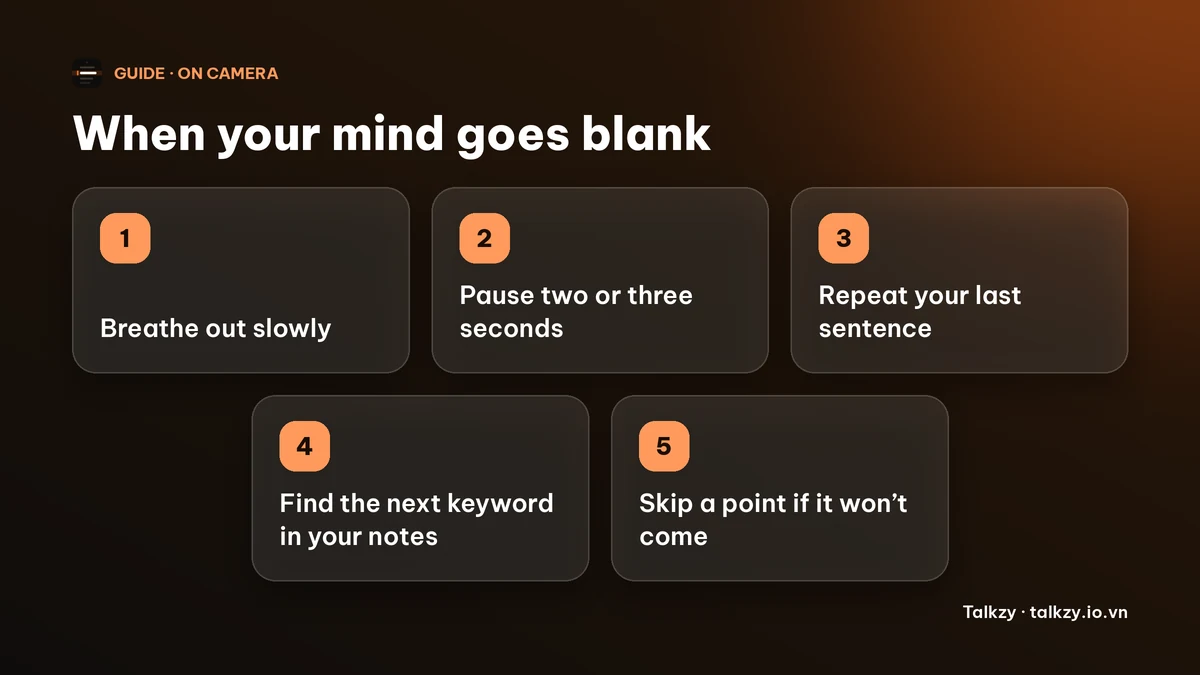
- 1Stop and breathe out slowly. Your body is in a stress response; one long exhale is the quickest way to calm it down.
- 2Say nothing for two or three seconds. Listeners read a pause as thinking, and to them it is not a mistake.
- 3Repeat your last sentence, or the last few words of it. Saying known words out loud often brings the next thought back.
- 4Look at your notes, find the next keyword and carry on from there. You do not need to rebuild the exact sentence you lost.
- 5If the next point still won’t come, skip it and move on to the next one. The audience never saw your plan, so they will not miss it. You can return to it later or leave it out.
Avoid the common trap of apologising, laughing nervously or announcing “sorry, I forgot”. It makes a two-second gap look like a failure and raises your own stress.
Why does my mind go blank?
The usual cause is stress. Adrenaline narrows your attention, and a talk you only hold in memory has no backup. A few things make it more likely:
- Memorising word for word. If you lose one word, the whole chain breaks. Remembering the order of ideas is much more robust.
- Not having said it aloud enough. Reading a script silently is not the same as speaking it.
- Being watched. A camera with a red light or a full video call raises the pressure even when nobody is reacting.
- Tiredness, no water, no food. They matter more than people expect.
Going blank does not mean you are bad at speaking. It happens to experienced speakers too; they just know how to cover it.
How do I recover when I am recording a video?
Recording is the easiest case, because you can stop. Do not push through a take you already know is bad.
- Stop, breathe, and go back to the start of the sentence, not the start of the video. Pause for a second so the cut is clean.
- Record in sections. Splitting a script into parts of 20–40 seconds means a blank costs you one part. Our guide on recording a video in sections shows how.
- Keep going if it is small. A short pause can be trimmed later, so you don’t always need to redo the take.
- Take a break after the third failed attempt. Water, a short walk and a fresh start usually fix what a fourth try won’t.
How do I recover in a live call or a presentation?
Here you cannot redo anything, so the goal is to keep moving smoothly.
- Use a bridge phrase that buys time: “The key point here is…”, “Let me put it this way…” or “To summarise so far…”. It lets you restart the thought without silence.
- Repeat your last point in other words. It reads as emphasis, and your mind catches up in the meantime.
- Glance at your notes during a pause or while someone else is speaking, not in the middle of a sentence.
- On a call, a drink of water is a natural reason for a short pause.
- If you lose the thread completely, ask the room a simple question about the topic, or move to the next slide. Either gives you a few seconds to find your place.
How do I set up my notes so I can find my place fast?
Most blank moments turn into a long silence because you can’t find where you were. Fix that when you write the notes.
- Use short lines with one keyword in each, not full paragraphs. One glance should be enough.
- Number your sections or give each a title (“Problem”, “Example”, “Ask”). A title is the quickest way back into the thread.
- Use large type with space between the points, so your eyes land on the right line.
- Keep your opening and closing sentences word for word. The start sets your nerves, and the end is what people remember.
- Put the notes close to the camera, so a glance doesn’t pull your eyes far away.
A quick rehearsal helps more than anything else. Say the whole thing aloud three or four times, and deliberately practise one recovery: stop mid-way, pause, find your place and continue.
Where Talkzy helps
You can do all of the above with paper or a notes app. Talkzy is a teleprompter that can make the “find my place” part easier.
- In the iPhone and iPad app, voice-follow scrolls the script as you speak and waits when you stop, using speech recognition on the device. If you go quiet while you think, the text stays where you were instead of running ahead. The iPhone and iPad app is coming soon to the App Store.
- Start a line with # to make a section. While you record, you can retake from the current position or from the start of the section, so you do not redo the whole script after a blank.
- Talkzy for Mac is on the Mac App Store, for macOS 14 or later. It puts your script in a slim bar right under the camera, with # sections you can jump between, which makes a glance at your notes less visible on a call.
Frequently asked questions
- How long is too long to pause when you go blank?
- Two or three seconds feels very long to you but is rarely noticed by an audience. Longer than about five seconds is when people start to wonder, so use a bridge phrase or look at your notes before that.
- Should I tell the audience I lost my place?
- Usually not. They don’t know your plan, so a quiet pause costs you nothing, while an announcement draws attention to it. Say it only if the gap is long and you need to ask for a moment.
- Is it better to memorise or to use notes?
- For most talks, keywords and a clear order of ideas are safer than a word-for-word memory, because losing one word does not break the chain. Keep the opening and closing line exact and use notes for the rest.
- What if my mind goes blank during a video interview?
- Pause, breathe out, repeat the question in your own words and look at your notes if you have any. It is fine to say “let me think about the best example”. See our guide on using notes in a video interview.