How to memorize a script fast (and when you don’t need to)
Published October 1, 2026 · 6 min read
To memorize a script fast, break it into short chunks, learn each chunk by saying it out loud rather than reading it silently, link the chunks with a simple outline, and test yourself with the page turned away. Space the practice over a few sessions; one long cram fades quickly.
Most video scripts don’t need to be memorized word for word, though. This guide also helps you choose how much to memorize — the first line, the key points, or nothing at all with a prompter — so you spend the effort where it shows.
Do I need to memorize the whole script?
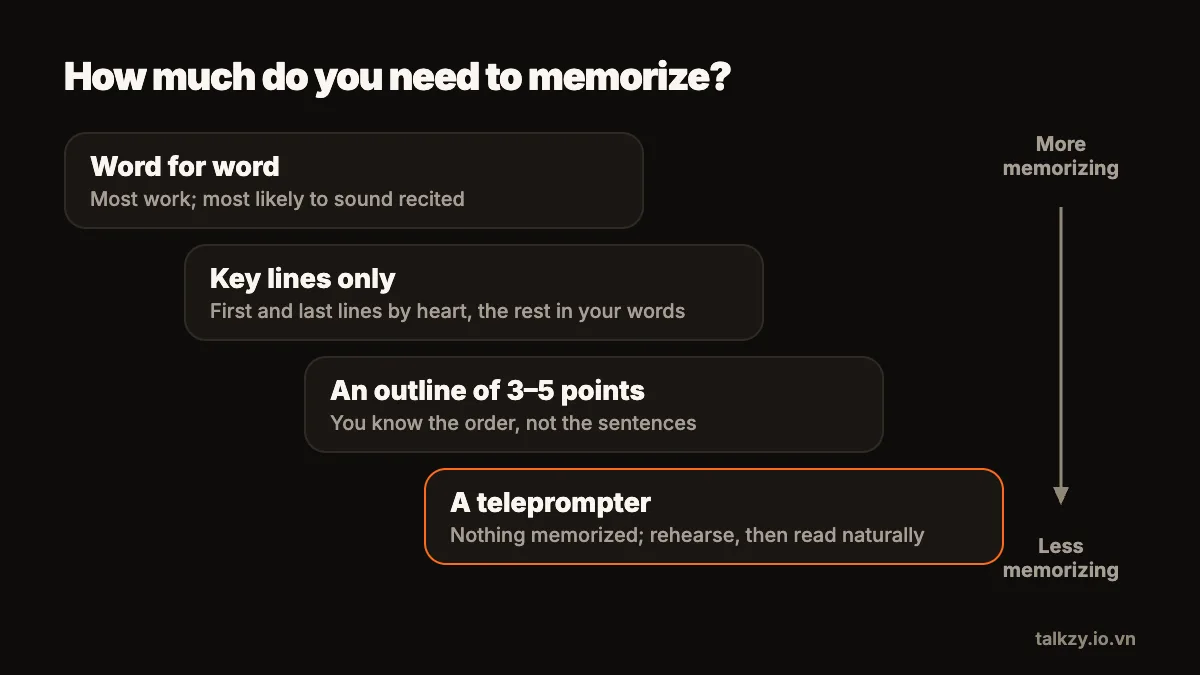
Usually not. Word-for-word memorizing takes the most time, and it is also the version most likely to sound recited: when you are concentrating on the exact next word, your face and voice go flat. Think of it as a ladder with four rungs:
- Word for word: needed for an actor’s lines, a legal statement or anything where exact wording matters.
- Key lines only: the first sentence and the last, memorized exactly, with the rest in your own words.
- An outline of three to five points: you know the order and the examples, and phrase it fresh each time.
- A teleprompter: nothing memorized, the full text in front of you near the lens.
For most talking videos the second or third rung gives the most natural result. Use a prompter when the wording must be exact but you don’t have days to learn it.
What is the fastest way to memorize word for word?
- 1Split the script into chunks of one to three sentences. Give each chunk a one- or two-word label.
- 2Read the first chunk aloud three times, then look away and say it. Check, fix the words you missed, and repeat until it comes out clean.
- 3Add the next chunk the same way, then say both together. Keep building: one, one-two, one-two-three.
- 4Write the first letter of each word on a card (“T i h t f y a h” for “This is how to film yourself at home”) and practise from the letters. It forces recall without giving the answer away.
- 5Say it at full voice, standing, the way you will on camera. Silent reading feels like learning but doesn’t hold up under pressure.
- 6Stop, sleep or take a break, and test yourself again later. Recall after a gap is what makes it stick.
How do I remember the order of the points?
Most blanks on camera are not forgotten words but a forgotten next point. Fix the order separately from the wording:
- Write the outline as three to five labels and learn it first. If you can recite the labels, you can always find your way to the next part.
- Make each point start with a word that links to the previous one, or tell it as a sequence: problem, cause, fix.
- Picture each point in a place in a room you know well, and walk through the room in your head. This old memory technique works well for a handful of points.
- Write the labels on a sticky note and put it beside the lens as a backup.
How do I make it sound natural once it’s memorized?
Once the words are in, practise meaning, not text. Say each chunk as if you were explaining it to one person, change the emphasis a few times, and keep the version that sounds like you. Record a practice take on your phone and listen without the picture: recited text tends to have an even, sing-song rhythm, while natural speech speeds up and slows down with the meaning.
If you lose a line on camera, pause, breathe and start the sentence again. Don’t stop the recording; a second of silence is easy to cut.
How do I record without memorizing the whole thing?
Record in sections. If each section is thirty seconds to a minute, you only need to hold one in your head at a time: read it twice, say it once without looking, then film it. Move on when you have one good take.
Or memorize only the opening line and read the rest from a teleprompter placed right under the lens. You get exact wording with a natural start, and your eyes stay near the camera.
How long does it take to memorize a script?
It depends on the length, the language and how familiar the material is, so there is no honest single number. A useful rule is to plan several short sessions rather than one long one, and to start at least a day before you film if the wording must be exact. If you have only an hour, memorize the first and last lines and the outline, and read or improvise the rest.
Where Talkzy helps
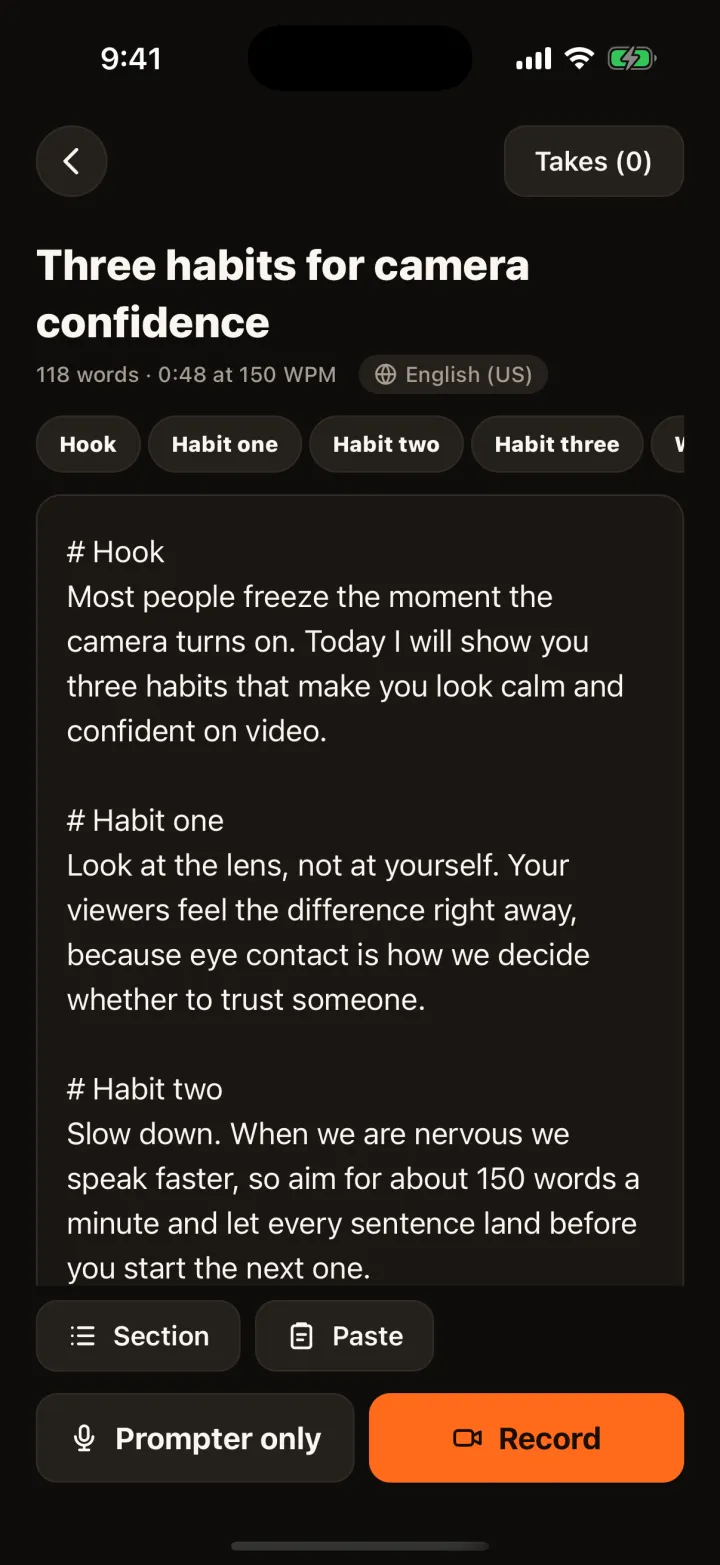
Talkzy is a teleprompter for iPhone and iPad, for the times you’d rather not memorize. Start each part with a line beginning with # and the script splits into sections you can rehearse, read and retake one at a time. The text runs in a narrow column right under the front camera, so reading still looks like eye contact.
With voice-follow (beta) the script follows your voice and waits when you pause; because it matches what you say against your own script, an ad-lib or a skipped line doesn’t throw it off, so you can mix memorized lines with read ones. Speech recognition runs on the device.